- Executive Summary
This project is for a fictitious state of Wonderland that aims at aligning the process of data collection related to the environment and increased public awareness pertaining to the climate change. The data is collected from the three ministries: Ministry of Defence (MoD), Ministry of the Environment (MoE) and Ministry of Land (MoL). After the system is analyzed that are associated with the three ministries, it would seem that common set of data related to environment are available to them. The needs of each ministry vary and the collection of data related to the environment supports the operations carried out by the ministries. The solution that enables the three ministries to work more efficiently is the shared information system. This solution reduces effort and time in relation to the information collection. However, for Wonderland, the organizational analysis serves as the perfect anecdote considering the strong bureaucratic system that characterizes it. Each ministry has their own and unique goals and strategies with poor communication in between them, necessitates the consideration of a new design addressing this issue and integrating these systems of the ministries.

- Introduction
The government of Wonderland (a fictitious nation) has come up with a policy in developing a new system related to the development of the environmental scenario. The environmental data will be collected and a system of environmental information will be sourced. The public participation will be allowed in the process, leading to the decision making. This is allowed as the environment is related to the concerns of the public.
This project’s purpose is to design a proposal related to the environmental data sharing among three ministries such as, MoD, MoE, and MoL in the fictitious state of Wonderland. Being the country endowed with high level of mobile phones and internet usage, the proposal can take the advantages of ICT. This paper, at first, will analyze the business domain that includes the stakeholder analysis and the organizational strategy. All the requirement of the business, consequently, will undergo analysis and along with the changes in management.
- Business Domain Analysis
- Strategy analysis
The strategy can be described as the organizational plan of action followed by it for achieving their goals within a specified time period, generally in the long run. As per Johnson and Scholes (2001), the organizational scope and direction is provided by the strategy with the help of resource configuration within the environmental change in fulfilling the expectations of the stakeholders. The involvement of the organizational strategy identifies the goals and the mission (Beynon-Davies, 2009). These goals and mission can be broken down to the principles of the organization. For the environmental system of the Wonderland, the mission is increasing the awareness of the public with regards to the climate change by the activation of the collaboration among the agents of the Wonderland, the members of the public, and the ones who have the charge of environmental data collection. The concerns of the strategic decisions are with the followings: (a) Organizational activities’ direction; (b) The activities are matched with the environment; (c) organizational capabilities supporting the direction chosen; (d) the expectations and the value of the stakeholders; and (e) the management and the implementation of change.
The strategy serves an organization in various ways as has been the case with Wonderland. Wonderland should use strategy as the way to establish the purpose of the organization. The strategy should also be used by the Wonderland as a response to the internal weaknesses and strengths as well as the complexity pertaining to the external threats and the opportunities. This should be done in achieving competitive advantage that is sustainable. Moreover, the organizational purpose of Wonderland should be established by the means of strategies as the firm’s competitive domains and the context of the organization. The strategies will also be helpful for Wonderland in defining the managerial processes and tasks with the perspectives that are functional, business, and corporate oriented. Finally, the strategy serves the purpose of a system that involves systematic, integrative, unifying, and coherent decisions’ pattern.
Additionally, there are different standardization for each ministry and their acceptance related to different accuracy level. For instance, the air pollution is calculated by the MoD by the use of volume/mass in obtaining gas emission percentages (for example grams/km3), where the application of MoE is with mass/process parameter (for example grams/second or grams/kilogram of consumed fuel) (Murena, 2004).
In a converse way, the concern of the MoL is regarding the surface water in the countryside and cities. However, the focus of the MoD is on the country’s border side. These differences are affected with the obtainment of the accurate information unless there is sharing, management, unification of the data in one system by the environmental professionals. There should be dissemination of the data via web service in permitting access of public and enhancement of their interaction.
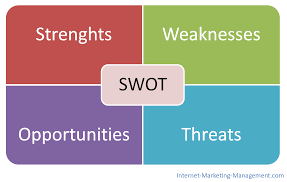
However, this project’s strategic planning has been the evaluation of the internal and external factors that can be affecting the project. Albeit, there have been several methods to analyze strategies, in this study, SWOT and PEST will be carried out. The external factors are looked upon by the PEST analysis, whereas the internal factors of the organization is examined by the SWOT analysis. Silva (2012) argues the advantages related to the application of both methods have the coverage of all aspects with the employment SWOT analysis and the PEST results. The figures below demonstrate the SWOT analysis and the PEST analysis.
However, this project’s strategic planning has been the evaluation of the internal and external factors that can be affecting the project. Albeit, there have been several methods to analyze strategies, in this study, SWOT and PEST will be carried out. The external factors are looked upon by the PEST analysis, whereas the internal factors of the organization is examined by the SWOT analysis. Silva (2012) argues the advantages related to the application of both methods have the coverage of all aspects with the employment SWOT analysis and the PEST results. The figures below demonstrate the SWOT analysis and the PEST analysis.
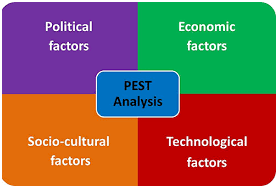
PEST Analysis (the project of new data collection)
Political
- The system of bureaucracy is the governing agent with regards to the relationship between the ministries and the government and within the ministry.
- The regulation of the government guaranteeing the freedom of speech.
- The pressure given politically in unifying the efforts in addressing the problem of climate change.
- The aligning of the political parties at national, local, regional, or European trading level
- Legislation (employment or taxation law)
- Relationship between the organization and the government
- Government’s attitude towards the competition and monopoly and government’s industry ownership
Economic
- Reduction of the cost pertaining to the IT departments
- The workforce’s high level of skills
- Cost of training
- High quality of infrastructure related to ICT (Mobile phones and Internet)
- Additional costs for the network of smart sensor that ‘builds and maintains’.
- Per capita GDP and the total GDP
- Inflation
- Consumer expenditure and disposable income
- Investment: by overseas companies, by private firms, and by the state
- Exchange rates and currency fluctuations
- Business cycles
Social
- Western style and democratic nation
- Education level is high
- The growing concern of the public regarding environmental consciousness.
- Growing usage of online services
- Support towards the centers of research
- Attitude to leisure and work
- Issues of green environment
Technological

- Wider network of mobile phones and broadband coverage
- Improved methods of data visualization (GIS technology)
- Smart network towards sensor
- Wide IT diffusion
- R&D expenditure
- Adoption rate pertaining to new technologies (Lawrence and Carr, 2009)
SWOT Analysis
Strength
- This is a mission undertaken by the government
- There is experience in the past in the three ministries
- The government provides funds coming from stable source
- Within the organization, there is strong infrastructure of ICT
- Workforce is skilled
Weakness
- Inter-ministry communication is poor
- Risk pertaining to the integration of different systems
- Timed and sensitive data
- Limitation of time
- The three ministries and the managers have differing perspective
Opportunities
- Desires of the public in participating in the decisions
- International attitude in cooperating with the addressing of the problem related to the climate change
- Education level is high
- High level of use of mobile phones and internet.
Threats
- Some ministry employs change resistance
- National level control accessing
- Conflict taking place with providers of internet (delay, poor service)
- Issues with web security (for example attacks by the hackers)
- Sustainability with changes related to the fast technology (Quincy, 2013)
- Organizational analysis
In conducting organizational analysis, the interviews and the daily work observations with the ministries’ employees are needed to be undertaken. In addition, the Wonderland’s history and the social component’s review have been necessary in understanding the entire system and the prediction of the major factor that has influence on the organizations in this country. The critical observation is also required with regards to the norms and the behaviors of the people especially with respect to the internet (Morgan, 1989). For instance, the report analysis is conducted from the providers of the internet in Wonderland.
The organizational culture can be defined as set of beliefs and values in a community regarding what is undesirable and what is desirable. In their community, the two things that are carried out are perceptions and beliefs. The reflections are the values of the aspirations of the community regarding the right way of doing things. Therefore, there is need for the organizational understanding in relation to the domain. The understandings are related to the following factors: (a) factors of organization (structure, culture etc) that influences strategies and solutions; (b) there can be difference in the suitable solutions that is dependent on the organizational culture; and (c) There is seize to be any correctness in the organizational culture, making way for only “different” cultures (Paul et al., 2010).
Thus, there will expectations by the citizens with respect to the government’s serious procedures and greater opportunities for participation to save their activities related to environment. This puts more pressure on the government in taking more actions to manage and share the environmental data among the ministries participating alongside the public. Second, such decisions have political dimensions. For example, the extent to which the people are allowable in the monitoring the environment and the way it would be affecting the neighboring countries. Moreover, the government regulations are followed by this decision along with the related laws to data sharing amongst the bureaucratic organizations. Apart from this, this act should be restated by the government as the ministries are the government sector’s integral part. Furthermore, there is continual development of technology and there is good experience of the citizens with regards to the use of IT. This usage of IT could catalyze the government employing ICT infrastructure of high quality in meeting the expectations of the public. There is also aim of the government in attracting people with them being enabled in collecting and sharing data with others visualization of the data on maps that are user friendly.

The corporate strategy is closely related to the organizational structure. The organizational structure not only affects economic performance and productivity, but also the staff’s job satisfaction and morale. The overall organizational effectiveness will be impacted by both individuals and sound structural design with the fill up of several positions within the structure. The organization can be termed as the social system and the people working within it will have the establishment of their own relationships and the social groupings and behavioral norms.
As far as the impact related to the information system’s organizational structure is concerned, there is building of the traditional information systems on the organizational structure existing. As far as the impact on the organizational structure having on the information system, there are new organizational forms, empowerment, and span of control.
The comparison can be drawn between the information system’s evolution and the change of organizational practices and structure. These surround pervasive computing and transactional processing systems. Moreover, there must be usage of devices all the time and all around us. The experience sharing via ICT can be done through community space, wiki, and blog. This has impact on the methodology and the development of the information system. The matrix structure is supported by the ICT having easier access to the information of cross functional nature (Mullins, 2010).
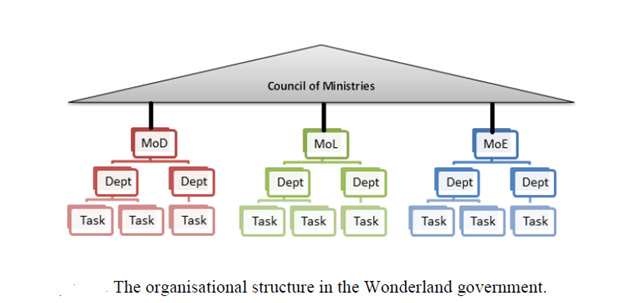
The strong bureaucratic system has been applied by the Wonderland government, where there is working of each ministry separately from one another. There is application usually by the bureaucratic organizations with a structure that is formal and hierarchical and where the lower levels are controlled by the top managerial level. In these bureaucratic system, where there is specification of the rules, the decision making and planning is carried out by the top level management that are implemented subsequently by the lower levels. It is clear that situation of the Wonderland government has the application of the centralized authority where the assignment of it has been with the organization’s top level. There is hierarchical shape in the organizational structure, where within these ministries there is division of work into tasks that are collected into roles with their assignment to the people. Furthermore, the ‘Greek temple’ style is followed as the communication is poor among the three ministries with the application of authority and power relationship. As a consequence to that, each ministry has their own ICT infrastructure and information system along with different database and applications as it own goals and strategies. The Wonderland government’s organizational structure is given in the figure below.
- Stakeholder analysis
The people to whom the system influences are the stakeholders. The definition provided by Beynon-Davies (2009) describes stakeholders as a group, person, or system outside or inside the organization having interest in the system of the organization. This is generically acceptable that the analysis of the stakeholder has the reflection on the business process and decision making (Brugha and Varvasovszky, 2000). This analysis reflects the stakeholders’ characteristics in accordance with the responsibility and power having direct effect on the workflow of the organization. For the environmental system of Wonderland, the identification of the stakeholders has been on the basis of their responsibilities and roles. The stakeholders in this project are:
- The government
- The Ministry of the Environment
- The Ministry of Land
- The Ministry of Defense
- The data collection station
- The members of the public
- The IT department
- Policymakers, research centers, and ecologists
- Smart sensor providers and Network providers
The government: The decision by this new initiator is building the new environmental system and setting the goals and the mission. The responsibility of the government includes the control of the project and to ensure that the following of the correct path takes place. There is also consideration that the government acts as the system’s funder and facilitator. Thus, the government of the Wonderland is a very important stakeholder as it takes the role of a financial provider having interest in delivering high performance, reliable and low cost system that enables the achievement of the system’s goals.
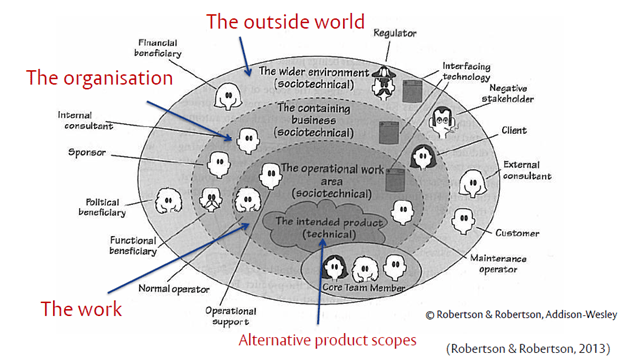
The Ministry of the Environment:The responsibilities and the roles performed by this department are same as the ones performed by the MoL and MoD. However, there are additional responsibilities are involved in this department. The responsibilities involved in this department include the management of the new environmental system. Thus, the department assumes the role of coordinating between MoD and MoL in identifying the common data that is retrieved from the newly formed system. In addition, the position of MoE allows it to have responsibility to produce the format of a unified data after having agreements with other ministries in facilitating the new system’s integrity. Finally, this department has the accountability to check the environmental data that the public entered prior to saving it on the database which is common (Robertson and Robertson 2013).
The Ministry of Land:The responsibilities and roles are performed by this stakeholder is same as MoD stakeholder.
The Ministry of Defense: This department takes the role of an internal stakeholder taking the role of client and actor. It can have the consideration of an actor as it is having a direct impact on the system’s development. Because it is the new system’s beneficiary, it can also be considered as a client. As a norm, it is applicable to the bureaucratic systems. This ministry’s systems and database is usable in transferring data with the database, which is new and common. Furthermore, its employees working on the current systems for the collection of the environmental data will be working as the operational staff in the new department of the environmental data collection.
The data collection station: This stakeholder group is secondary in nature that is considered as providers and operators. They have the responsibility to verify the data quality that has occurred from the monitoring of the equipments and smart sensors without the new system’s direct interaction. They have the interest in working conditions and the job security and having the preference to be stable.
The members of the public: These consist of stakeholders that are secondary and external considered being the new system’s clients. They are the new system’s beneficiaries having interest in the quality and value of the environmental data deliverable in the web service newly formed. This will have the allowance for participation on the web service that is newly formed as the data that the public collected is accepted by the system (Cadle et al., 2010).
The IT department:This is consisting of IT people in a group from the three ministries in question taking up the role of providers. They have the responsibility to develop the new system and act as maintenance operators for the system’s whole cycle.
Policymakers, research centers, and ecologists: They consist of stakeholders that are secondary and external taking bystanders’ role. They have the concerns with quality, value and environmental issues. For example, the policymakers in Tourist companies or in Insurance companies.
Smart sensor providers and Network providers: These are the stakeholders that are secondary and external. Their role is to extent provision of necessary services and equipment without the new system’s direct interaction. They have interest in liquidity and new contracts.
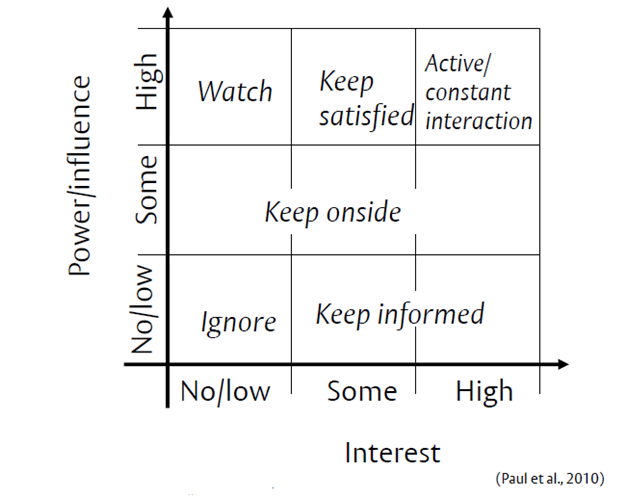
Furthermore, there are several techniques related to the stakeholder mapping. One of such had been proposed by Mendelow (1981). Mendelow (1981) investigated the dynamic relation between the organizational process and the stakeholder’s power (Olander and Landin, 2005). The figure provided below indicates the classification of the stakeholder with the interest and power in the new system of environment. It is clear that MoE and the government have the highest priority followed by MoL and MoD. The type of analysis has the provision of general pattern for the system developers and decision makers that provides helping hand during the life cycle of system development.
Furthermore, there are several techniques related to the stakeholder mapping. One of such had been proposed by Mendelow (1981). Mendelow (1981) investigated the dynamic relation between the organizational process and the stakeholder’s power (Olander and Landin, 2005). The figure provided below indicates the classification of the stakeholder with the interest and power in the new system of environment. It is clear that MoE and the government have the highest priority followed by MoL and MoD. The type of analysis has the provision of general pattern for the system developers and decision makers that provides helping hand during the life cycle of system development.
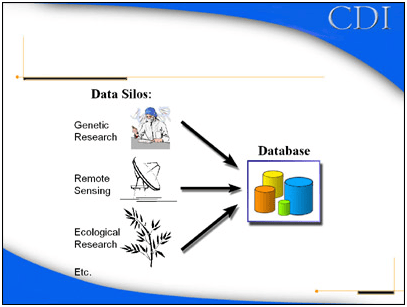
The analysis above makes it clear that the government of Wonderland has the intention to introduce and design a new system that is supportive of environmental data collection in producing low cost and high quality data. In addition, this new system is enabled in attracting the public with the visualization of the data and allowing them their participation in increasing their awareness with respect to the climate change problem. Nonetheless, the current situation speaks of the ownership of each ministry with data collection station, with laboratories, smart sensors and other environmental media measuring the samples physically (EPA, 2005). The department of data collection has collected data, which is stored subsequently in the database of the ministry and the management of it has been by their applications of legacy. The figure below shows the architecture of the current system and the new system’s proposal.
The analysis above makes it clear that the government of Wonderland has the intention to introduce and design a new system that is supportive of environmental data collection in producing low cost and high quality data. In addition, this new system is enabled in attracting the public with the visualization of the data and allowing them their participation in increasing their awareness with respect to the climate change problem. Nonetheless, the current situation speaks of the ownership of each ministry with data collection station, with laboratories, smart sensors and other environmental media measuring the samples physically (EPA, 2005). The department of data collection has collected data, which is stored subsequently in the database of the ministry and the management of it has been by their applications of legacy. The figure below shows the architecture of the current system and the new system’s proposal.
The proposal of the new system integrates the process pertaining to the department of the new data collection without the legacy application and the databases’ integration. This is because such integration can be causing several technical difficulties and could be leading to a situation that is risky. The concentration of these difficulties has been on the inconsistencies at the time when three older databases are migrated to the formation of a new one. This is especially true with respect to the fact that the designing of the three separate databases has been on the accordance to the different specifications and methodologies.
Moreover, this would seize to be efficient as the collection of specific data by each ministry with other common ones. It is clear that the legacy systems are merged that have resulted in failing of both the current system and the shared project. Thus, the proposal of the new system has been the up keeping of the systems of old legacy and the creation of the new web services that have connection with the common database and saving of the common environmental data. The enablement of this solution has been with three legacy systems having consistency and has the minimizing effect of the redundant data. In addition, the system that is newly shared should have application with the EAI (Enterprise Application Integration) as the data description variation solution and old database systems classification.
- Business requirement analysis
The analysis of the system requirements provides summary of what the system should be doing. Generally, the BRS, which is business specification of the system, is submitted separately as a document including assumptions, descriptions, constraints, dependencies, and the interface requirement (for example communication interfaces, hardware, and user) (Perry, 2006). The categorization of the requirements can be the followings: (a) the requirements of the business such as, technical and general; and (b) the requirements of the solution such as, non-functional and functional. The requirements of the filters can be confirmation of quality, removal of the conflicts, evaluation of the feasibility, duplicate/overlapping requirements.
The business processes should include the system functions, but the specification should not be included in the technical details. In addition, the project managers and the senior managers should extent approval of the BRS. As far as this project is concerned, there will be collection of the requirements after the interviews are conducted with the key system users and the managers in the three ministries collectively along with the observations. Moreover, the workshops will be attended with a team of IT specialist and ecologists from the MoL, MoD, and MoE. This is done in specifying the traits related to the new shared system and differences of it with other systems where it is stressed that the business process is aligned with each ministry.
- Requirement specification
Functional requirements: The ability of the web system should involve the undertaking of the following:
Managing the authority privilege: The inclusive of this are the administrative privileges, user logout/login, and user registration. The system’s user should be registering for taking the web service’s full advantage. The three ministry’s employees working in the new department should be taking into account the privileges of the employees where they can be viewing, deleting, adding and updating the stored data in the database that is common. However, the stored environmental data can be viewed only in the legacy systems. The system administrator can be limiting or extending the privileges of the employees. The members of the public holding the privileges of the user will have the ability of adding environmental data to the common database after checking of the data by the MoE. The unregistered users will be allowed in viewing the environmental data that has the storage in the system (Perry, 2006).
Managing environmental data: There are four main processes of this function:
- Addition of new department employees (a group of MoE, MoD, and MoL) and environmental data should have the ability for the data addition into the system and visualizing it on the map. The public users will have the ability of visualizing/adding data in the system after checking is done by MoE in relation to its suitability.
- The environmental data is updated. The employees who are authorized are the people having the ability of changing data having been stored in the system. Moreover, the updates made should have reflection on the map.
- The environmental data is searched. This process will provide the enablement of the users in retrieving the environmental data from the common database and the systems of three legacies. The users are employees who are member of the public and can come from the three ministries.
- The environmental data removed. The employees should have the ability of deleting the environmental data, which is necessary, from the system (Perry, 2006).
Validation of environmental data: This function is related to the employees of the MoE having the ability of checking the suitability of any added data by the public prior to its addition into the system.
On a map, visualization of the environmental data: The data visualization’s functionality should be supported by the web system. Any change to the stored data in the system should have the alignment with the data visualization update.
Non-functional requirements: The performance of the system is provided with the help of specifying by this requirement. The following traits should be present in the collection system of the new environmental data:
Reliability: the reason for this is that the three ministries will not have the acceptance of change if the confidentiality or the reliability lacks.
Security: The system must not be allowing access that is unauthorized in ensuring the protection of the data.
Up-to-date: There is continual change in the in the environmental data as there will be uncertain factors influencing it. Thus, every time, it will be updated and checked.
Accuracy: There should be sameness in the system’s data as the measurement equipment should read it.
Usability: There should be easy understanding and usability of the system. The public users will be encouraged by this to be using it and ensuring that the ministries’ employees would be liking and accepting it.
Efficiency: The effort and time should be saved by the new system. This should be ensuring of the utilization of maximum resource and the working on the minimization of the redundant data.
Maintainability: The repairing and the maintenance of this system should be easy.
Flexibility: There should be ability of it in accepting any changes that are required in the future to be done.
Cost-effectiveness: There should be ability of the new system in saving money in comparison to the current system.
- Business system modeling
Peter Checkland defined CATWOE as SSM’s (Soft Systems Methodology) part. It is nothing but thinking’s checklist. The business analysts’ use this generic technique in identifying the business goals and the way the solutions would be affecting the people and the business that has involvement in it. The CATWOE has six elements: (a) clients; (b) actors; (c) transformation; (d) weltanschauung (world view); (e) owner; and (f) environmental constraints.
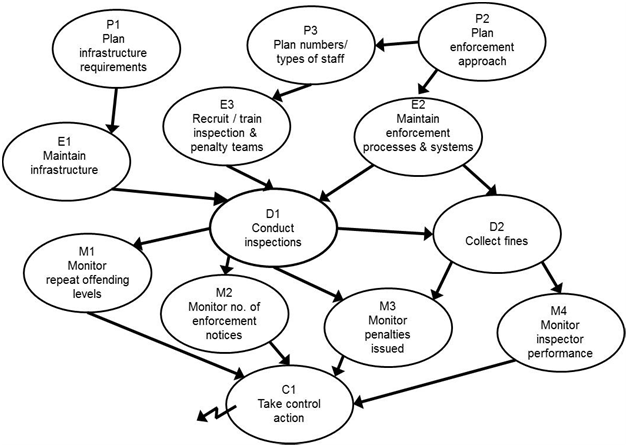
The BAM (Business activity model) is a model that is conceptual and representing the activities of the business from the business perspective, where there is association of the business activities with one of the types mentioned below: doing, enabling, planning, monitoring or controlling activities (Paul, et al., 2010). The figure provided below shows the BAM for the system of environmental data collection from the perspective of business.
The BAM (Business activity model) is a model that is conceptual and representing the activities of the business from the business perspective, where there is association of the business activities with one of the types mentioned below: doing, enabling, planning, monitoring or controlling activities (Paul, et al., 2010). The figure provided below shows the BAM for the system of environmental data collection from the perspective of business.
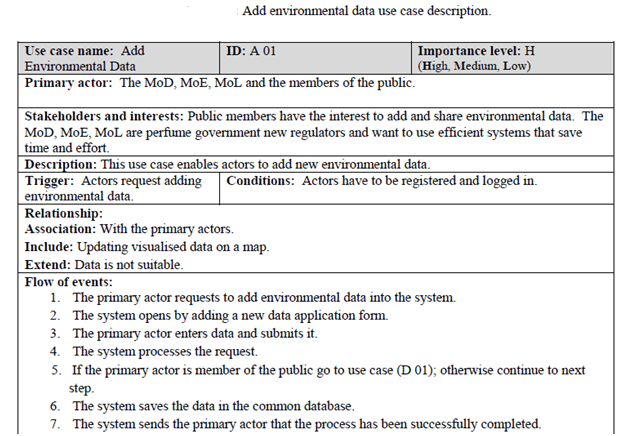
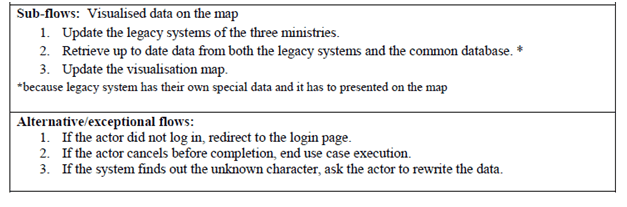
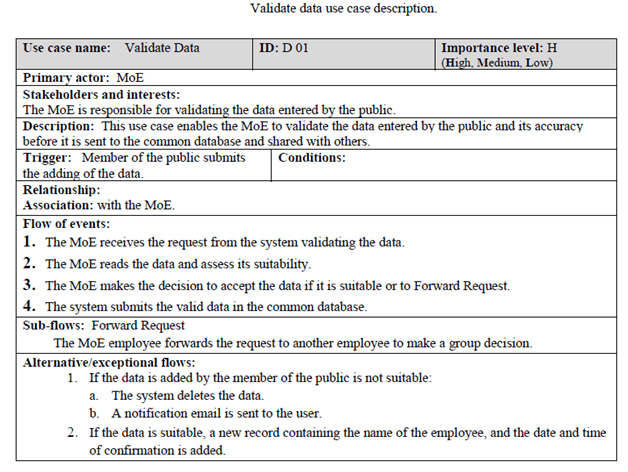
In a converse way, the technique known as the use case has been representing system requirement within the context of a business. The description of the use case is the way the use case scenario is informed and identifies its circumstances. In this project, the description will be provided to only two use cases because of word limitations.
- Business process modeling
The diagram of the use case provides summary to whole process of the business and representing the interaction between the new system and the actor.
Business process modeling representing ‘to-be’ process and ‘as-is’ process
This project represents the systems of the three ministries ‘as-is’ works in completely isolated way from each other and identical way (Dufresne and Martin, 2003). Thus, just one model of business process will shown which is the ‘as-is’ system.
In the previous section, there is provision of the use case diagram of the proposal system with the representation and examples of the description of the use case. These scenarios or the description can have the critical identification of what is done by the system and how it is done. The specifications are also given as to when there is beginning and completion of the use case and who were actually the primary actors. Furthermore, the constraints were defined by it and the alternative activities are provided. This is usable as a guide representing the model of the business process.
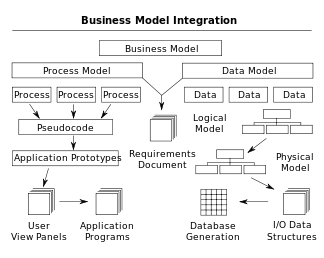
Thus, the model of business process will be using the description of the use case as an input in drawing tasks that should be followed and in sequencing logical order in performing them. Nonetheless, the differences between ‘to-be’ and ‘as-is’ that are significant are data visualizing on the map and the public participation. Thus, addition by the public with respect to the environmental data shall be used as ‘to-be’ business process model’s example.
- Change Management Approach
The change undertaken by the government with regards to the sharing of the environmental system has been a reactive change. The project director is considered to be the working styles of the people and change needed in them. In this time, other ministries and the staff associated with them takes participation in the training sessions. This required to be running the new system by obtaining feedback and ensuring acceptance. The policies and systems will be checked as the managers scrutinize the performance reports. This will lead to the integration of the new system with the MoL and MoD. The support is provided with the availability of the support and training. However, the same process related to the maintenance and testing should be done prior to the MoE implementation.
The change that are sought to be undertaken must take place with respect to the poor inter-ministry communication and strong bureaucratic system. The stakeholders with respect to their intentions to accept change is affected to a great extent in this context. The TRA (theory of reasoned action) talks about the behavioral intentions of the stakeholders, the formation of which is dependent not only on the subjective norms, but also by their attitude and beliefs (Hale, Householder and Greene, 2002).
The compatibility is required with the norms of the stakeholders. The new proposal, in this context, is suggestive of integration at the departments of data collection. However, there is no need of communication with other ministries in running this new system. Moreover, the new system’s acceptability is dependent, generally, on its usability and usefulness. There is general belief amongst the stakeholders that some advantages will be created by this new system. When this happens, there is increase in the chances with respect to the acceptance of the new system. Thus, the proof should be provided as to the usability and the usefulness when the plans are formulated for the changes to take place.
- Conclusion
The new data collection system related to the environment has the designing such that it has compatibility with the Wonderland’s strong bureaucratic system. The knowledge participation of the public is also taken into the consideration. The environment of the project is analyzed with respect to the requirements of the business, requirements of the stakeholders, organizational culture and structure, and the project environment. The new design tried to reduce time taken to collect the data related to the environment, cost and effort. The improvements are made in the e-governance and the related services while bringing in synergy among the ministries with the help of this new system.
References
- Beynon-Davies, P. (2009) Business Information System, England: Palgrave Macmillan.
- Brugha, R. and Varvasovszky, Z. (2000) Stakeholder analysis: a review, Health policy and planning, 15(3), 239-246.
- Cadle, J., Paul, D. and Turer, P. (2010) “Business Analysis Techniques: 72 Essential Tools for Success”, British Computer Society.
- Dufresne, T. and Martin, J. (2003) “Process Modeling for E-Business”, INFS 770 Methods for Information Systems Engineering: Knowledge Management and E-Business.
- Environmental Protection Agency. (2005) Quality Standard for Environmental Data Collection, Production, and Use by Non-EPA (External) Organizations [online]. Available at: http://www.epa.gov/oeitribalcoordination/External%20Standard%20with%20Annexes.pdf. [Accessed 2 December 2012].
- Hale, J. L., Householder, B. J. and Greene, K. L. (2002) “The theory of reasoned action”, The persuasion handbook: Developments in theory and practice, 259-286.
- Lawrence, P. and Carr, A. J. N. (2009) Delivering Results: Managing What Matters, Springer Science & Business Media, p. 44.
- Mendelow, A. L. (1981) “Environmental Scanning–The Impact of the Stakeholder Concept”, ICIS 1981 Proceedings.
- Morgan, G. (1989) Creative Organisation Theory, Sage Publications, p.26.
- Mullins, L. (2010) “Management and Organisation Behaviors”, FT.
- Murena, F. (2004) “Measuring air quality over large urban areas: development and application of an air pollution index at the urban area of Naples”, Atmospheric Environment, 38(36), 6195-6202.
- Paul, D., Yeates, D. and Cadle, J. (2010) Business Analysis (2nd Ed.), British Computer Society.
- Paul, D., Yeates, D. and Cadle, J. (2010) Business Analysis (2nd Ed.), British Computer Society.
- Perry, W. E. (2006) Effective Methods for Software Testing: Includes Complete Guidelines, Checklists, and Templates, Wiley.
- Quincy, R. (2013) “SWOT Analysis: Raising capacity of your organization”, Rutgers School of Social Work.
- Robertson, S. and Robertson, J. (2013) Mastering the Requirements Process, 3rd ed., Pearson Education.
- Silva, N. (2012) “SWOT analysis vs. PEST analysis” [online]. Available at: http://creately.com/blog/diagrams/swot-analysis-vs-pest-analysis/ [Accessed 29 November 2012].

